Untangle legacy spaghetti and catch circular dependencies before they cause outages.
Technical Foundation
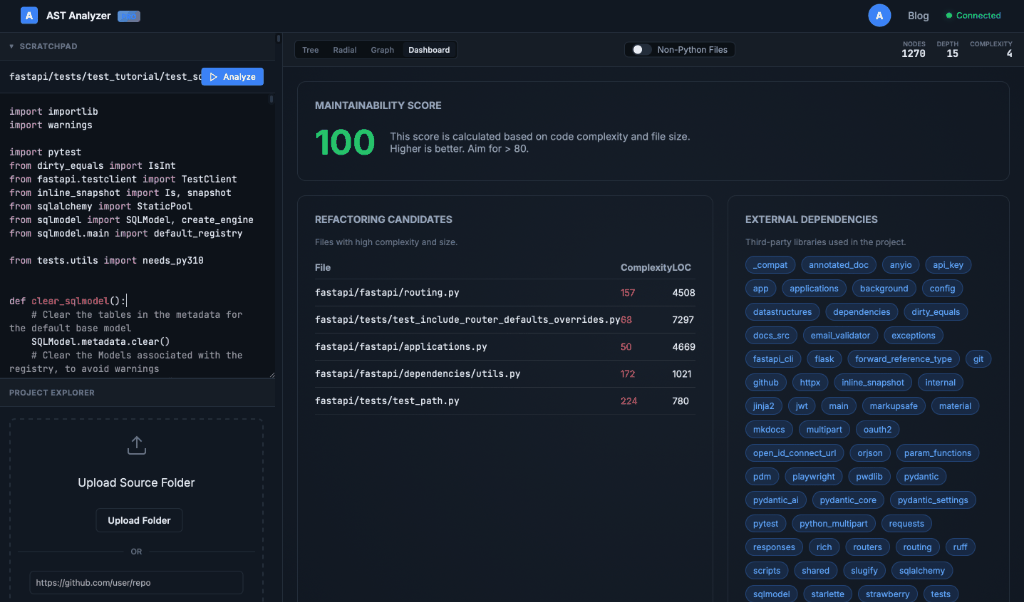
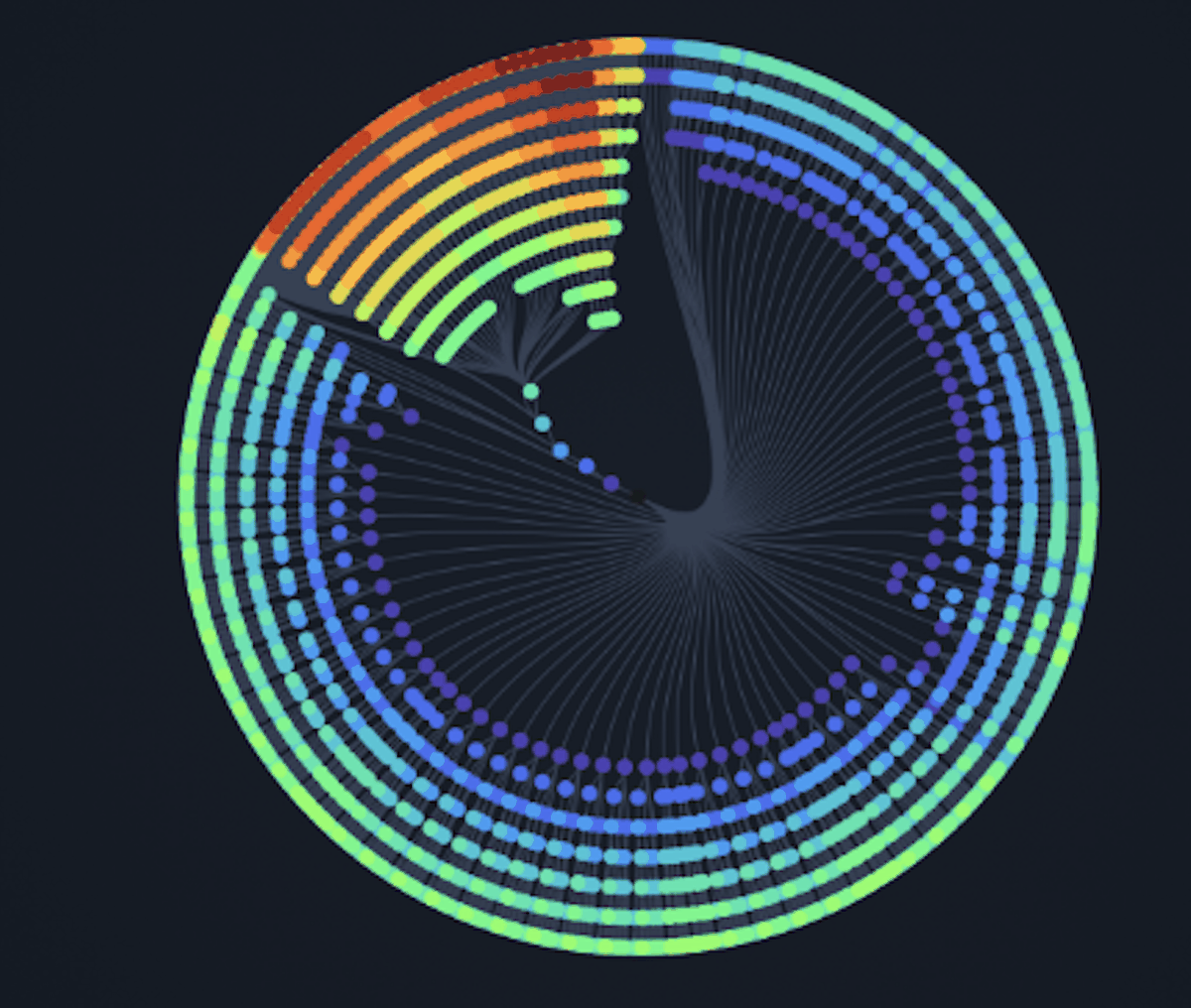
High-fidelity Dependency Graphs mapping module imports across Python, JS, and TS.
Spot and Eliminate Technical Debt
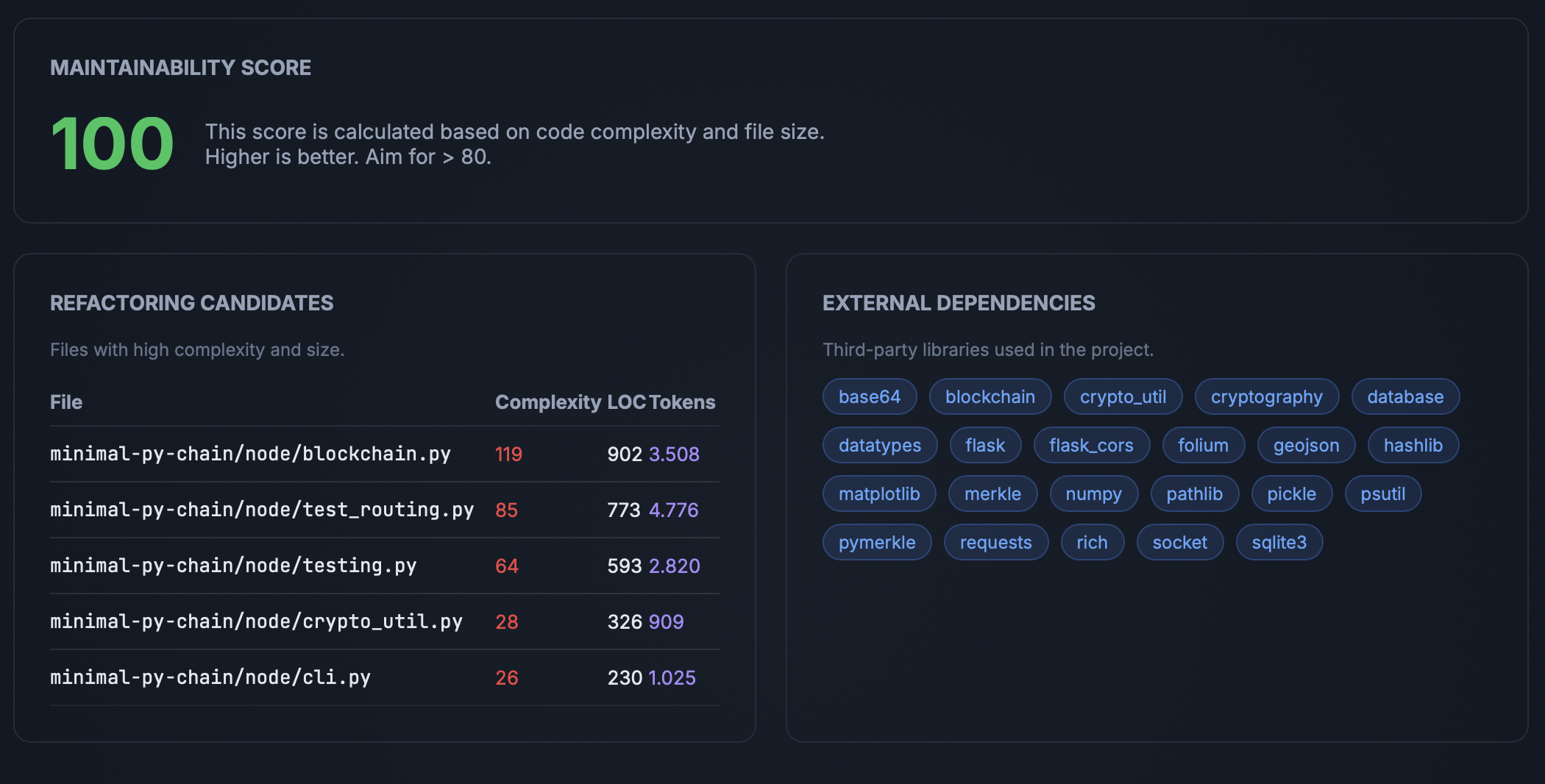
Identify "maintenance nightmares" at a glance and prioritize refactoring based on objective
metrics.
Technical Foundation
Automated McCabe Cyclomatic Complexity analysis calculated for every function in your
project.
Onboard Humans & AI Instantly
Understand any repository in minutes without reading thousands of lines of code.
Technical Foundation
Works by generating high-fidelity maps of your codebase via deterministic and accurate AST
analysis.
Frequently Asked Questions
Everything you need to know about visualizing your codebases.
Creview automatically maps out your entire codebase — whether it's Python, JavaScript,
TypeScript, or a full-stack project — by analyzing its structure and dependencies. Simply
upload your project folder or paste a GitHub URL, and Creview generates an interactive
dependency graph showing how all modules, classes, and functions connect. This bird's-eye
view eliminates hours of manual code reading and helps you identify entry points, core
modules, and architectural patterns instantly.
An AST Visualizer transforms source code into an interactive Abstract Syntax Tree diagram,
revealing how a compiler or interpreter perceives your code. Creview uses
tree-sitter — a production-grade parser — to support Python,
JavaScript, TypeScript, HTML, CSS, and JSON. It renders the hierarchical
structure as a zoomable, pannable graph where you can inspect nodes, expressions, and
control flow across your entire multi-language project.
A Cyclomatic Complexity tool measures the number of independent execution paths through your
code using McCabe metrics. High complexity scores (above 10) indicate functions that are
difficult to test, maintain, and debug, directly correlating with bug density and technical
debt. Our analyzer calculates complexity for every function and highlights hotspots in red,
allowing you to prioritize refactoring efforts and improve code maintainability before
issues arise.
Creview's Dependency Graph automatically detects circular import and reference chains by
tracing module relationships across your entire project — whether Python, JavaScript, or
TypeScript. Circular dependencies appear as loops in the graph visualization, making them
immediately visible. You can click any module to inspect its import chain and use the
interactive scratchpad to document refactoring strategies, preventing architectural
anti-patterns before they reach production.
Yes. Creview displays complete class inheritance trees, module structures, and import maps
for Python, JavaScript, and TypeScript projects. The dependency graph mode reveals
parent-child class relationships, while the AST view exposes the internal structure of each
definition — including decorators, properties, and method signatures. This dual
visualization works across your full stack, so you can understand both your backend Python
services and your frontend JS/TS components in a single tool.
Upload your entire project folder or ZIP file, or paste a GitHub URL. Creview simultaneously
processes Python, JavaScript, TypeScript, HTML, CSS, and JSON files — resolving cross-file
relationships and building a unified dependency graph across your entire stack. You can
filter by language, search for specific functions, and toggle non-parseable files on or off.
This whole-project view is essential for understanding large, mixed-language codebases and
planning architectural changes.
McCabe metrics quantify code complexity by counting decision points like if-statements,
loops, and exception handlers. Functions with McCabe scores above 10 require exponentially
more test cases and have higher defect rates. Our Cyclomatic Complexity tool automatically
calculates these metrics for every function and color-codes them in the visualization,
allowing you to spot technical debt hotspots instantly and prioritize refactoring based on
objective data rather than intuition.
No. All code analysis — regardless of language — happens in-memory during your active
session only. Your source code is never persisted to disk, logged, or used for training AI
models. Once you close the session, all data is immediately discarded. We prioritize your
intellectual property and privacy, making Creview safe for analyzing proprietary Python
backends, JavaScript frontends, and confidential full-stack projects without security
concerns.